


From the Clinic; "Could a pair of custom orthotics really make that much difference?"
One of the most common questions I'm asked in clinic is whether custom orthotics actually work.
Some patients arrive expecting them to be a miracle cure, while others have already tried off-the-shelf insoles without success and understandably wonder whether a custom device could really be any different.
The answer is that it depends entirely on the diagnosis.
This patient demonstrates why making the correct diagnosis first is so important, and why custom orthotics can sometimes achieve remarkable results when they are prescribed for the right reasons.
Patient presentation
A lady attended my clinic with persistent pain affecting both feet.
She described pain beneath her heels together with aching through the middle of both feet, making walking increasingly uncomfortable. In addition to the foot pain, she reported swelling affecting both feet and ankles together with a sensation of tightness in her lower legs.
Her symptoms had gradually begun to affect everyday activities, and she was becoming increasingly frustrated by the lack of progress.
She also recalled sustaining a significant fall down a flight of stairs approximately 25 years previously, after which she had experienced intermittent foot problems over many years. More recently, she had also begun to develop discomfort affecting her knees and hips.
MRI imaging had already excluded fractures whilst confirming two important diagnoses: plantar fasciopathy and osteoarthritis affecting the midfoot.
Assessment
Having established the diagnosis, the next question became:
Why were these tissues becoming overloaded?
Clinical assessment demonstrated biomechanical factors that were increasing stress through both the plantar fascia and the arthritic joints within the midfoot.
Rather than simply treating the painful structures themselves, we discussed how altering the forces passing through the foot might reduce irritation of both conditions simultaneously.
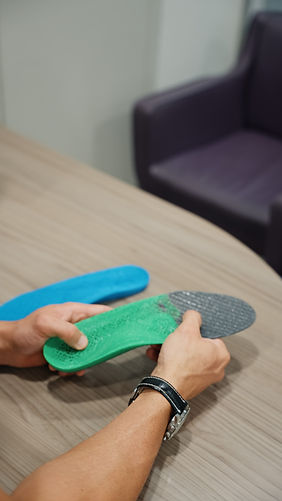
Custom 3D-printed foot orthoses were prescribed to improve load distribution during walking.
At the fitting appointment, the orthoses were carefully checked against the patient's feet to ensure the alignment matched the intended prescription.
On first standing, they felt comfortable and provided good support. We discussed the importance of a gradual bedding-in period whilst allowing both the patient and the orthoses to adapt to one another.
The diagnosis explained
Plantar fasciopathy and midfoot osteoarthritis frequently occur together.
The plantar fascia helps support the arch of the foot, while the small joints of the midfoot absorb and transfer forces during walking.
When foot mechanics become less efficient, both structures can be subjected to increased repetitive loading.
The result may be heel pain, aching through the arch or midfoot, reduced walking tolerance and progressive loss of function.
Although injections and shockwave therapy can both have an important role in treatment, neither addresses the underlying mechanical forces that continue to overload the foot during every step.
What we did

After discussing the diagnosis, we agreed that improving the patient's foot mechanics should be the first stage of treatment.
Custom orthoses were fitted and the patient was advised that they should be introduced gradually over the following days, allowing time for the feet to adapt.
We also discussed additional treatment options should symptoms fail to improve, including shockwave therapy for the plantar fascia and image-guided injections for the arthritic joints.
Alongside the foot pain, we discussed the swelling affecting both lower limbs.
Advice was provided regarding regular walking, leg elevation where practical and compression hosiery. I also recommended discussing longer-term management of the swelling, together with weight management strategies, with her GP.
A review appointment was arranged four weeks later.
The treatment plan
At the follow-up consultation, the patient described a remarkable improvement.
After only four weeks of wearing the orthoses, she estimated that her symptoms had improved by approximately 90%.
She had returned to almost all of her normal daily activities and was significantly more comfortable when walking.
The only ongoing difficulty was finding footwear with sufficient depth to comfortably accommodate the orthoses. We discussed suitable footwear options and agreed that she should continue wearing the orthoses in shoes that fitted well while gradually replacing unsuitable footwear.
Given the excellent response, no further intervention was required.
Shockwave therapy and injections were no longer necessary, and the patient was discharged with advice to return should symptoms recur.
What can we learn from this?
One of the biggest misconceptions surrounding custom orthoses is that they are simply expensive insoles.
In reality, they are prescribed to alter the way forces are distributed through the foot.
When those forces are contributing to conditions such as plantar fasciopathy or midfoot osteoarthritis, improving foot mechanics can substantially reduce pain whilst allowing patients to remain active.
This case also demonstrates the importance of selecting the least invasive treatment first.
Although injections and shockwave therapy remained available if required, neither proved necessary because the underlying mechanical overload had been addressed successfully.
My specialist thoughts
Patients often ask me whether orthotics "fix" the foot.
I usually explain that they don't change the shape of the foot or permanently strengthen muscles.
What they do is alter how forces are transmitted through the foot during every step.
When those forces are the reason a tissue has become painful, changing the mechanics can make a profound difference.
This patient is a good example.
By first establishing the diagnosis and then addressing the underlying mechanical overload, we were able to achieve an excellent outcome without progressing to more invasive treatments.
Every patient is different, and not everyone will experience such rapid improvement. However, this case highlights why I believe treatment should always begin with understanding why the pain has developed before deciding how to treat it.
About the author
Mr Liam Stapleton MSc, PGCert, PGDip, FFPM RCPS(Glas), FRCPodM
Mr Liam Stapleton is a Consulting Podiatrist, Independent Prescriber and Specialist in Podiatric Sports Medicine. He has completed postgraduate qualifications in Independent Prescribing, Musculoskeletal Ultrasound, Advanced Clinical Practice, the Theory of Podiatric Surgery, and Podiatric Sports Medicine. His clinical practice focuses on the diagnosis and management of complex foot and ankle conditions, combining detailed clinical assessment with diagnostic ultrasound to provide accurate diagnosis and evidence-based treatment.
If you're struggling with persistent foot or ankle pain and would like a specialist assessment, including diagnostic ultrasound where appropriate, appointments can be booked with Kent Sports Podiatry at clinics across Kent.


Comments